

Strategy Formulation Process:
In my travels as an IBM consultant, I saw and witnessed a lot about how “strategy” is discussed or how it is applied at various companies. Most times, there is at least a playbook on how strategy is developed but more times than not, strategy formulation can be misunderstood or wrongfully applied.
There are many schools of thought on strategy formulation. Everyone knows Porter’s five forces from business school and I am sure we have all seen enough SWOT charts to last a lifetime. What I have found is most essential comes down to a few basics that should begin at the highest levels of the company’s leadership team.
Step 1. Know who you are; play to your strengths. How many of us have taken Myers Briggs or some other personality test? The main point of these tests is to show you what are character strengths. They teach you (mostly) to focus on your strengths. In business your organization will fall into one of the three categories below (i.e. strengths).
- Does your company rely on customer relationships to drive a significant amount of business? Meaning your company values and receives feedback from customers on the importance of exceptional customer service (i.e. Customer Intimacy). Companies in this category would include St. Regis, Nordstrom, Jet Blue and HSBC.
- The next category is Operational Efficiency. This is a term that can be overused or misunderstood, just like the common definition of Cloud. Essentially, does your company focus on having their products or services available quickly and for the lowest cost. Most manufacturing companies fit into this category. Companies in this space are Wal-mart, Southwest Airlines and FedEx.
- The last category is Product Leadership. The product or service is the only thing that matters for your company and they will spare no expense on ensuring the product stands out above any other. Typically, a consumer will be willing to pay higher prices if they know they are receiving a quality product. One of the best examples here is of course Apple. The design and ease of use of their products are at the center of everything they release. Product Leadership can also be the recognized in Mercedes, BMW and Nike.
Once you determine your strengths, ensure your leadership team agrees as well. Nothing kills strategy quicker than if the head of one business unit believes the company is Operationally Efficient rather than all the other units driving towards Customer Intimacy.
Also, recognize the difference between what is said inside the walls of your company versus what is marketed outside your company. Meaning, every company will tell you their focus is on the customer, which could confuse some inside the company if they hear messages that the company’s strategy is Product Leadership.
Step 2. A Clear Mission and Vision.
Does your company have a clear mission and vision statement? A mission statement tells people why you exist, what is the purpose for having a business and having people work for the company. A vision statement will describe where the company is heading.
Sometimes, the mission and vision can be combined. I have seen this to be an art form at some companies. In any case, a company should at least know why it exists and where it is heading.
Some good examples of mission and vision statements are below;
Nordstrom
In store or online, wherever new opportunities arise, Nordstrom works relentlessly to give customers the most compelling shopping experience possible. The one constant? John W. Nordstrom’s founding philosophy: offer the customer the best possible service, selection, quality and value.
Nike
“To bring inspiration and innovation to every athlete* in the world.”
Honest Tea
Honest Tea seeks to create and promote great-tasting, healthier, organic beverages. We strive to grow our business with the same honesty and integrity we use to craft our products, with sustainability and great taste for all.
Hormel Foods
“Building upon our heritage of innovation and quality, together we will elevate the everyday experience by making Hormel Foods the favorite part of any eating occasion.”
Step 3. Now start talking Strategy
With steps 1 and 2 accomplished, you have now laid the groundwork for initial discussions on strategy within your company. I am particularly fond of J. Luftman’s simplistic graph to help begin strategy discussions.
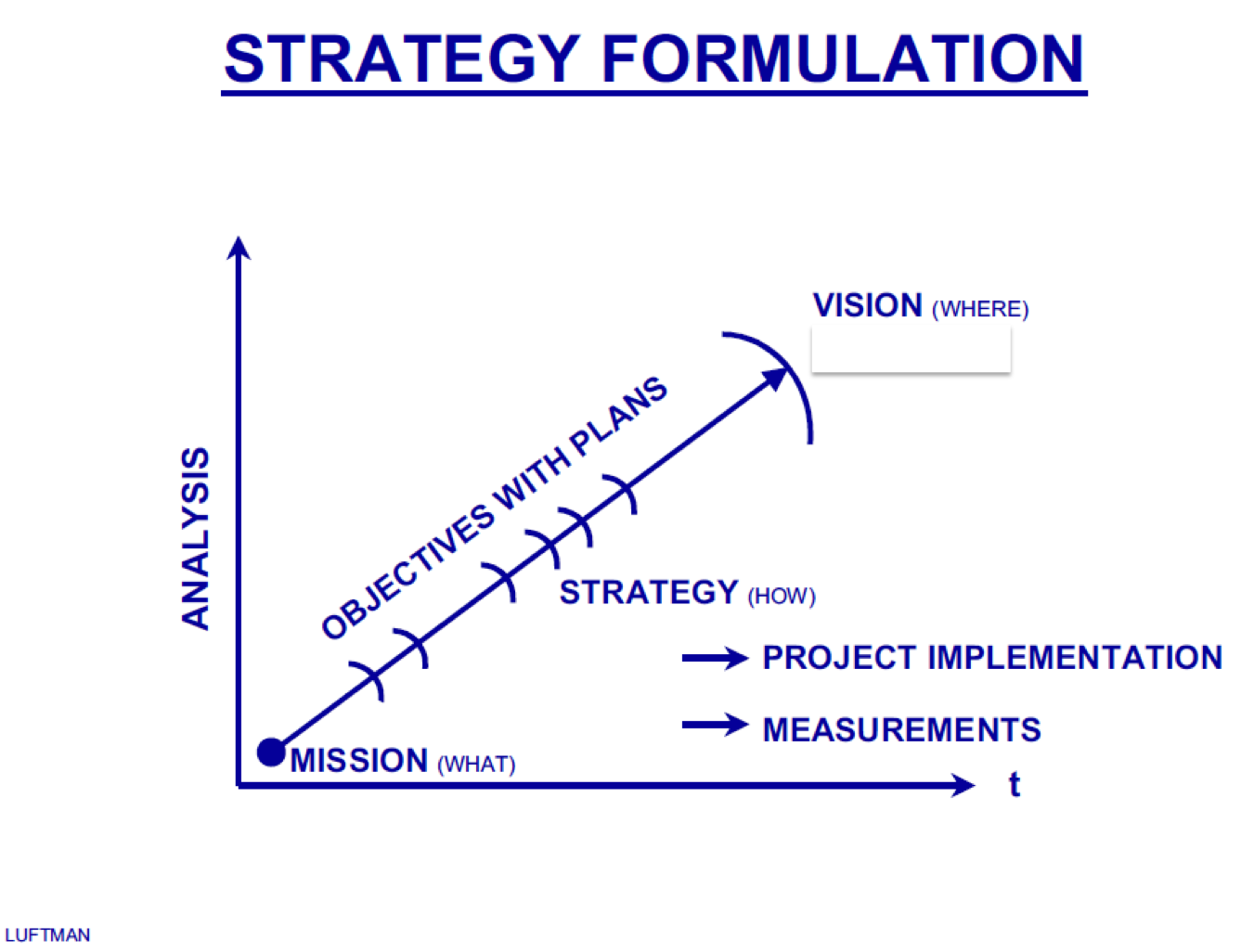
As pictured above, strategy can begin simply by asking “How are we going to achieve our goals” towards our vision as a company.
I also appreciate having Project Implementation and Measurements as part of the initial strategy discussion. With projects, at a company level, what % of projects is aligned with your strategy? Meaning are you just implementing projects that keep the lights on or are there a good percent of your projects that focus on your company’s strengths?
Regarding measurements, do you have any quantifiable means to ensure you are hitting your company’s goals (i.e. marketshare, revenue by customer segment, benchmarks, geography penetration)? I also like the quote by Tom Peters “What gets measured gets done”.
Step 4. Agree on the Strategy Horizon
It’s very easy for some to get caught up with a strategy process. Thousands of hours and dollars are devoted to off-site meetings, PowerPoint’s and resources trying to align a company’s strategy. One key point is that the senior team agree on the strategy horizon, meaning how long to look out and develop some strategy goals. Usually three to five years is a good initial start.
Typically, there should at least by one annual review of the strategy to measure and validate the strategy is on track. I have seen some companies tweak their vision statements a bit during this time but just like personal finance or your health, a yearly checkpoint is minimum.
Be careful not to go too far out on strategy. I have seen companies that have ten-year strategic plans but struggle to hit their yearly goals. It comes down to execution and focus and if you are having challenges meeting short-term goals, longer-term goals will be even more difficult.
In closing, decide what fits best for your company. Having respectful and challenging conversations on if the company has the right resources to accomplish the goals within the desired time frame is a must. It may not be realistic to grow revenue 25% in the next 3 years if the resources (both human and capital) are not ready in the pipeline to achieve the goal.
Like Myers Briggs, focus on what you do well and make strategy work for you.
In Part 2, I will go over a little more in depth of how to achieve all this within your organization and what a yearly strategy update would look like.
 The Jesski's